

How to Use the Harris County Property Tax Database Before Your 2026 Tax Bill Arrives
July 28, 2026 | Michael Saegert, Atty at Law

Your HCAD protest may be over, but your 2026 property tax bill is still taking shape.
By late July and early August, many Houston and Harris County property owners are moving out of protest season and into the next stage of the property tax calendar. Values are being finalized, taxing units begin working through proposed rates, and property owners start wondering what their final bill may look like.
That is where the Harris County property tax database can become useful.
The property tax database can help you review proposed tax rates, taxing units, public meeting information, and estimated tax impact before the official tax bill arrives. It does not replace your appraisal notice, ARB order, exemption records, or final tax bill, but it can help you understand what may be coming next.
This guide is educational. It is designed to help Houston property owners better understand public property tax information before the 2026 bill arrives. It is not legal advice about a specific property, exemption, protest, ARB order, payment issue, or tax bill.
Michael Saegert is a Houston property tax attorney and former HCAD counsel with more than 30 years of Texas property tax experience. He understands that many property owners feel confused after protest season because the value stage may be over, but the tax bill has not arrived yet.
This guide explains what to check, what the terms mean, and when it may be worth asking for help.
Quick Answer: What Is the Harris County Property Tax Database?
The Harris County property tax database is an online tool that helps property owners review information related to property tax rates, taxing units, and estimated taxes before tax bills are finalized.
Through the database, Houston and Harris County property owners may be able to review information such as:
-
The taxing units connected to a property
-
Proposed tax rates
-
Adopted tax rates, once available
-
Estimated taxes if proposed rates are adopted
-
Public meeting information
-
Taxing unit contact details
-
Updates during the tax-rate adoption period
The database is especially useful in August and September because that is when local officials are proposing and adopting tax rates that affect how much property owners may pay.
In simple terms, the database helps answer this question:
“Now that my value is mostly set, what tax rates and taxing units may affect my 2026 property tax bill?”
Why Houston Property Owners Should Check the Database in August and September
The Harris County property tax process does not end when HCAD protest season slows down.
For much of the spring and early summer, property owners focus on appraised values, protest deadlines, iSettle, informal review, evidence, and ARB hearings.
After that, attention shifts to the tax-rate side of the process.
That means property owners should begin reviewing:
-
Which taxing units apply to the property
-
Whether proposed tax rates are available
-
Whether MUD or special district taxes apply
-
Whether the taxable value looks correct
-
Whether exemptions are reflected properly
-
Whether estimated taxes look higher than expected
-
Whether public tax-rate meetings are scheduled
The database is not only for people who protested. It can also be useful for homeowners, investors, business owners, and new property owners who want to understand how the next stage of the tax bill is developing.
The Property Tax Timeline After Protest Season
By late July, the property tax process begins shifting from protests to assessment and tax-rate activity.
Here is the general flow:
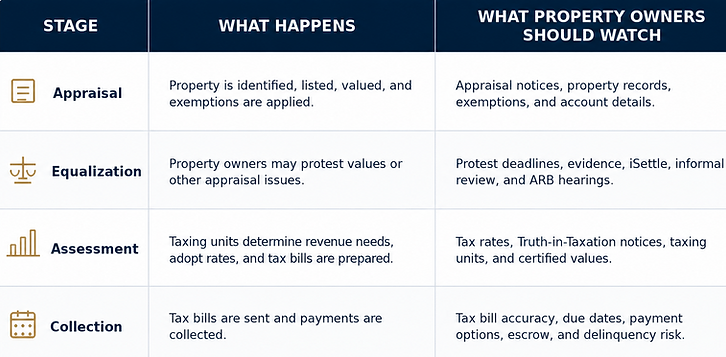
Most property owners spend the most time thinking about the first two stages. That is understandable. Appraisal notices and protest hearings are immediate and stressful.
But the assessment stage is where tax rates become very important.
A value reduction can help, but the final bill depends on the value, exemptions, taxable value, and the tax rates adopted by the units that tax the property.
For a broader overview, read After HCAD Protest Season: Houston Tax Bill Timeline 2026.
What Information Can You Find in the Property Tax Database?
The exact information available may depend on the property, taxing units, and timing, but the database is intended to help property owners review tax-rate and estimated-tax information.
Important items to look for include:
Taxing units
These are the government entities that tax your property.
Examples may include:
-
School district
-
Harris County
-
City of Houston or another city
-
Hospital district
-
Community college district
-
Flood control district
-
MUD or utility district
-
Other special districts
Two properties with similar appraised values can have different tax bills if they are located in different taxing units.
Proposed tax rates
A proposed tax rate is a rate a taxing unit may consider adopting. It may not be final.
Property owners should review proposed rates carefully, especially when comparing the possible 2026 tax impact to prior years.
Estimated taxes
The database may show estimated taxes based on proposed rates. These estimates can help owners understand what the bill may look like if those rates are adopted.
Estimated taxes are not the same as the final bill.
Public meeting information
Taxing units may hold public meetings before adopting tax rates. The database may help property owners find information about those meetings.
Taxing unit contact information
If a question relates to a tax rate, taxing unit, or public meeting, the relevant taxing unit may be the appropriate place to contact.
This is different from HCAD, which handles appraisal and protest matters.
What Are Proposed Tax Rates?
A proposed tax rate is a rate being considered by a taxing unit.
It is not always the final adopted tax rate.
This matters because a property owner may look at proposed numbers and worry that the bill is already final. In many cases, the rate still has to go through the public tax-rate process.
A proposed rate can still be important because it gives property owners an early look at what a taxing unit may adopt.
When reviewing a proposed rate, ask:
-
Which taxing unit proposed the rate?
-
Is this rate higher or lower than last year’s rate?
-
How does it compare with the no-new-revenue rate?
-
How does it compare with the voter-approval rate?
-
When is the public meeting?
-
What would this rate mean for my estimated taxes?
This review can help you understand why your bill may change even after a successful protest.
What Is the No-New-Revenue Tax Rate?
The no-new-revenue tax rate is a comparison rate.
In simple terms, it is intended to show the rate that would produce about the same amount of revenue from the same properties as the prior year.
For property owners, the no-new-revenue rate can help answer this question:
“Would this proposed rate raise more revenue from existing properties than last year?”
It does not mean your personal tax bill will stay the same.
Your own bill may still change because of:
-
Your taxable value
-
Exemptions
-
Taxing units
-
Special districts
-
Prior-year balances
-
Property changes
-
Ownership changes
-
Tax rates adopted by each unit
The no-new-revenue rate is useful, but it is not the only number to review.
What Is the Voter-Approval Tax Rate?
The voter-approval tax rate is another comparison rate used in the property tax process.
In general, it helps identify the point at which certain taxing units may need voter approval before adopting a rate that increases revenue beyond the allowed threshold.
For a homeowner, this term can be confusing because it sounds like every tax-rate decision goes directly to voters. That is not always how it works.
The practical point is this:
The voter-approval rate helps taxpayers compare proposed rates against a legal benchmark.
When reviewing the database, compare the proposed rate, no-new-revenue rate, and voter-approval rate together. That comparison can help you better understand the direction of the tax-rate discussion.
Why Your Estimated Tax Bill May Still Change
The numbers you see in the database may change before the final bill arrives.
That can happen because:
-
Proposed rates may not be final
-
Taxing units may adopt different rates
-
Exemptions may still need to be reflected correctly
-
Certified values may be updated
-
Appraisal corrections may still affect certain accounts
-
Prior-year balances may affect the amount due
-
Mortgage or escrow information may affect how the bill is handled
This is why the database should be treated as a planning tool, not the final word.
Use it to review possible tax impact, but continue checking official records when bills are issued.
What Houston Property Owners Should Check Before the 2026 Bill Arrives
Before the 2026 property tax bill arrives, review your account carefully.
Use this checklist:
-
Confirm the final value after any protest
-
Review any iSettle, informal settlement, or ARB result
-
Check whether the correct exemption is applied
-
Compare market value, appraised value, assessed value, and taxable value
-
Review every taxing unit listed for the property
-
Check for MUD or special district taxes
-
Compare proposed tax rates with prior-year rates
-
Review any estimated taxes shown in the database
-
Confirm owner name and mailing address
-
Confirm whether your mortgage company or escrow account should receive the bill
-
Look for prior-year balances or delinquent amounts
-
Save copies of notices, orders, bills, and database screenshots
This review does not guarantee that every issue can be fixed, but it can help you identify problems earlier.
For a related guide, read Value Reduced, Taxes Still High? Texas Property Tax Guide.
What If a MUD or Special District Is Listed?
If a MUD or special district appears on your property, review it carefully.
MUD stands for Municipal Utility District. A MUD or other special district may help fund infrastructure, utilities, drainage, water, roads, or related services.
These taxes can significantly affect the final bill.
That is why a homeowner may compare their property to another similar home nearby and wonder why the tax bills are different. The answer may be that one property is located inside a MUD or special district and the other is not.
If your bill has been higher than expected, review each taxing unit instead of looking only at HCAD’s appraised value.
For more detail, read Are MUD Taxes Included in Texas Property Taxes?
What If Your Homestead Exemption Is Missing?
A missing homestead exemption can make a property tax bill much higher than expected.
Before the bill arrives, check whether your exemption is reflected on the property account.
Pay close attention if:
-
You recently bought the home
-
You changed your mailing address
-
You inherited the property
-
You received returned mail notices
-
You applied for an exemption but are unsure if it was approved
-
You expected an over-65, disability, veteran, or surviving spouse exemption
-
Your taxable value changed sharply
A missing or removed exemption should be reviewed promptly. Waiting until the tax bill is due can create more pressure.
For more information, read Property Tax Exemptions in Texas: How to Lower Your Property Tax Bill.
What If the Taxable Value Looks Wrong?
If the taxable value looks wrong, do not assume the issue is only the tax rate.
Taxable value can be affected by several account-level details, including:
-
Exemptions
-
Appraisal caps
-
Ownership changes
-
Special appraisal rules
-
Property classification
-
Prior-year corrections
-
Property record errors
If the taxable value does not match what you expected after a protest, settlement, ARB hearing, or exemption application, compare the account record against your documents.
Useful documents may include:
-
Notice of Appraised Value
-
Protest confirmation
-
iSettle or informal settlement result
-
ARB order
-
Exemption approval or denial
-
Property record card
-
Prior-year tax bill
-
Closing documents, if recently purchased
Some issues may involve appraisal records or correction remedies rather than tax rates.
For more detail, review property tax appraisal corrections in Texas.
What If You Recently Bought the Property?
New homeowners often misunderstand the first full property tax year after purchase.
A prior owner may have had exemptions, tax ceilings, appraisal caps, or other benefits that do not apply to the new owner in the same way.
That can make the bill feel unexpectedly high.
If you recently bought a home, review:
-
Whether your homestead exemption was filed
-
Whether the prior owner’s benefits were removed
-
Whether the taxable value changed
-
Whether the property is in a MUD or special district
-
Whether your escrow estimate was accurate
-
Whether the mailing address is correct
-
Whether any protest result was applied properly
The database can help you see the taxing units and possible tax impact, but you should still verify your exemption and account details directly.
What If You Protested and Won a Reduction?
If you won a protest reduction, use the database to understand how that reduction may affect estimated taxes.
Review:
-
Original noticed value
-
Final value after protest
-
Taxable value
-
Exemptions
-
Proposed tax rates
-
Taxing units
-
Estimated taxes
A value reduction can help, but it may not lower the final bill as much as expected if tax rates, taxable value, MUD taxes, or exemption issues still increase the amount due.
This is why the post-protest review matters.
If something does not match the protest result, gather your documents and review the account before the bill arrives.
What If You Lost at the ARB or Still Disagree With the Result?
If your protest went to an ARB hearing and you disagree with the result, the database may help you understand estimated tax impact, but it does not decide whether you have a post-ARB option.
Depending on the facts and deadlines, some property owners may need to review:
-
Arbitration
-
Litigation
-
Appraisal corrections
-
Procedural issues
-
Payment requirements
-
Whether further action makes financial sense
For more detail, read What Happens After an ARB Hearing in Texas?
If your protest was dismissed or you missed a hearing, read HCAD Protest Dismissed? What to Do If You Missed Your ARB Hearing.
What If You Cannot Pay the Tax Bill?
The database may help you estimate the bill before it arrives. If the estimated amount already looks difficult to pay, do not wait until the deadline is close.
A payment issue is different from a valuation issue.
If the bill seems incorrect, review the value, exemptions, taxable value, or account records.
If the bill is correct but unaffordable, review payment deadlines, penalties, interest, and collection risks as early as possible.
Unpaid property taxes can lead to penalties, interest, collection fees, lawsuits, and foreclosure risk.
For more information, review delinquent property tax issues.
When the Property Tax Database May Reveal a Problem
The database may help you notice issues before the bill arrives.
Possible warning signs include:
-
The wrong taxing units appear
-
A MUD or special district appears unexpectedly
-
The exemption does not seem to be reflected
-
The taxable value looks much higher than expected
-
The proposed tax-rate impact seems unusually high
-
The owner name or mailing address looks wrong
-
A prior-year balance appears
-
The estimated taxes do not match what you expected after a protest
-
A recent protest reduction does not appear to be reflected
Not every concern is a legal issue. Some questions may be directed to HCAD, the Harris County Tax Office, a taxing unit, or a mortgage company.
But if the issue involves a disputed value, ARB order, correction, exemption, or account error, it may be worth getting a focused review.
Why Former HCAD Counsel Experience Can Matter
After protest season, many property owners feel like they are dealing with several separate systems at once.
There is HCAD.
There is the ARB.
There is the Harris County Tax Office.
There may be a school district, city, MUD, or other taxing unit.
There may also be a mortgage company or escrow account.
Michael Saegert’s former HCAD counsel experience helps him understand how these pieces fit together.
With more than 30 years of Texas property tax experience, he helps property owners review appraisal records, protest results, ARB orders, exemptions, corrections, and tax-bill concerns with practical judgment.
The goal is not to make the process more intimidating.
The goal is to help property owners understand what they are looking at, what may still matter, and when a problem should be reviewed before it becomes more expensive or difficult to address.
Speak With a Houston Property Tax Attorney
Your 2026 property tax bill may not be final yet, but the next stage of the process is already moving.
Before the bill arrives, review the Harris County property tax database, your HCAD account, exemption records, taxable value, taxing units, and any protest result. If something does not make sense, it is better to review the issue early than wait until payment pressure begins.
Michael Saegert helps Houston and Texas property owners understand property tax disputes, appraisal records, ARB results, corrections, exemptions, and tax-bill concerns.
If you are unsure what the database is showing or how your protest result may affect your 2026 bill, get a clear review before the issue becomes more stressful.
(Nothing to pay unless we achieve results.)