

After HCAD Protest Season: What Happens Before Your 2026 Property Tax Bill Arrives?
July 22, 2026 | Michael Saegert, Atty at Law

For many Houston and Harris County property owners, July feels like the end of property tax protest season.
By this point, you may have filed a protest, reviewed an iSettle offer, attended an informal meeting, prepared evidence, gone to an ARB hearing, or received a written order. After all of that, it is natural to wonder:
“What happens next before my 2026 property tax bill arrives?”
The answer is important.
After HCAD protest season, the focus begins to shift from property values to tax rates, certified values, taxing units, Truth-in-Taxation notices, tax bills, and payment deadlines.
This guide is educational. It is designed to help Houston property owners understand the public property tax process and what to watch for before the 2026 tax bill arrives. It is not a substitute for legal advice about a specific property, protest, exemption, ARB order, or payment issue.
Michael Saegert is a Houston property tax attorney and former HCAD counsel with more than 30 years of Texas property tax experience. He understands that many property owners feel relief after the protest stage, then confusion when the tax-rate and billing stage begins.
This guide explains what happens next.
Quick Answer: What Happens After HCAD Protest Season?
After HCAD protest season, the property tax process moves toward certified values, tax-rate adoption, tax bill preparation, and collections.
In simple terms:
-
HCAD values property and handles protests.
-
The Appraisal Review Board resolves protested values.
-
Certified values are provided to taxing units.
-
Local taxing units adopt tax rates.
-
Property tax bills are prepared and mailed.
-
Property owners review and pay their bills.
This is why your property tax bill may not be final immediately after your protest is resolved.
A protest may affect the value used in the calculation, but the final bill also depends on exemptions, taxable value, school district rates, city and county rates, MUD taxes, special districts, prior balances, and other account details.
If your protest is over, your next job is to make sure the final value, exemptions, account details, and tax bill all make sense.
Why This Matters in Late July
July is a transition point in the Houston property tax calendar.
Earlier in the year, the main focus is usually the Notice of Appraised Value and the protest process. Property owners are asking questions like:
-
Is my HCAD value too high?
-
Should I file a protest?
-
What evidence should I submit?
-
Should I accept an iSettle offer?
-
What happens at an ARB hearing?
By late July, many property owners are asking a different question:
“My protest is over. What should I watch for before the bill arrives?”
That is the right question to ask.
The property tax process does not end when the protest stage ends. The value side of the process is only one part of the final bill.
After protest season, property owners should start watching for tax-rate information, exemption accuracy, certified values, tax-bill timing, and payment deadlines.
The Four Stages of the Texas Property Tax Process
The Texas property tax process can be understood in four broad stages.
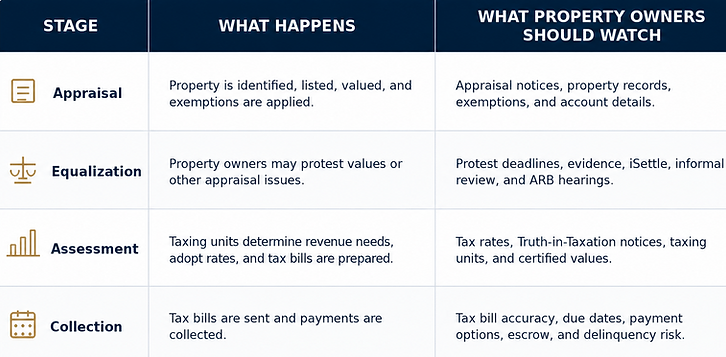
Most homeowners focus on the first two stages. That is understandable because appraisal notices and protests are immediate and stressful.
But the assessment and collection stages are where the final tax bill takes shape.
What Changes After July 25?
After the equalization stage, the focus begins moving away from protest hearings and toward tax-rate decisions.
This does not mean every issue is finished for every property owner. Some owners may still be reviewing ARB orders, dismissed protests, post-hearing options, corrections, exemptions, or other account issues.
But for the broader property tax system, the next stage is about preparing for the tax bill.
This is when property owners should start thinking about:
-
Final value after protest
-
Certified value
-
Taxable value
-
Exemptions
-
Taxing units
-
Proposed tax rates
-
Adopted tax rates
-
MUD or special district taxes
-
Billing timelines
-
Payment deadlines
If your value changed after a protest, do not stop there. Make sure that change is reflected correctly before the bill arrives.
What Is a Certified Value?
A certified value is part of the appraisal roll used by taxing units when they prepare to adopt tax rates and levy taxes.
For a property owner, the important point is this:
The value that matters for billing is the value that eventually flows into the tax calculation.
If you had a protest, settlement, ARB hearing, correction, or exemption issue, you should confirm that the final account information reflects the correct result.
This may include checking:
-
Final appraised value
-
Assessed value
-
Taxable value
-
Exemption amounts
-
Property characteristics
-
Ownership information
-
Mailing address
-
Taxing units
-
Prior-year balance
Small account errors can create bigger problems later if they are not caught before the bill is due.
Why Your 2026 Tax Bill Is Not Final Yet
A common misunderstanding is that the protest result alone determines the tax bill.
It does not.
A successful protest may reduce the value used to calculate taxes, but your final bill depends on other moving parts.
Those may include:
-
Taxable value after exemptions
-
School district tax rates
-
City tax rates
-
County tax rates
-
MUD taxes
-
Hospital, community college, flood control, or special district rates
-
Prior-year balances
-
Escrow or mortgage handling
-
Exemption issues
-
Payment deadlines
This is why a homeowner can win a value reduction and still feel that the bill is high.
For more detail, read Value Reduced, Taxes Still High? Texas Property Tax Guide.
What Is Truth-in-Taxation?
Truth-in-Taxation is the public process used when local taxing units calculate, publish, discuss, and adopt property tax rates.
This stage matters because property owners often focus only on HCAD. But HCAD does not set the tax rate.
HCAD determines values and administers the appraisal side of the process. Local taxing units adopt tax rates.
Those taxing units may include:
-
School districts
-
Harris County
-
City of Houston or other cities
-
Community college districts
-
Hospital districts
-
Flood control districts
-
MUDs and other special districts
During the tax-rate process, property owners may see terms such as:
-
No-new-revenue tax rate
-
Voter-approval tax rate
-
Proposed tax rate
-
Adopted tax rate
-
Tax-rate meeting
-
Public notice
These terms can feel technical, but the practical point is simple:
Taxing units decide how much revenue they need and what rate to adopt. That rate affects your final tax bill.
No-New-Revenue Rate vs. Voter-Approval Rate
Two common terms appear during the Truth-in-Taxation process.
No-new-revenue tax rate
The no-new-revenue rate is generally designed to show the rate that would produce about the same amount of property tax revenue from the same properties as the previous year.
It helps taxpayers compare the relationship between last year’s revenue and this year’s taxable values.
Voter-approval tax rate
The voter-approval rate is a calculated rate that generally limits how much certain taxing units may increase property tax revenue without voter approval.
The exact rules can vary depending on the type of taxing unit.
For property owners, the important takeaway is that these rates are comparison tools. They help the public understand proposed tax increases, tax-rate decisions, and the effect on property owners.
They do not replace the need to review your own account, value, exemptions, and taxing units.
Where Houston Property Owners Can Review Proposed Tax Information
After protest season, property owners should watch for public tax-rate information from official sources.
Useful places to review include:
-
HCAD property account records
-
Harris County Tax Office resources
-
Texas.gov property tax database
-
Taxing unit websites
-
Public notices from school districts, cities, MUDs, and other entities
-
Truth-in-Taxation information
This is especially important if your property is located in a MUD or special district.
A property owner may focus on HCAD and miss the fact that multiple taxing units are involved in the final bill.
If your tax bill has been unusually high in prior years, review which taxing units apply to your property before the 2026 bill arrives.
When Do Harris County Property Tax Bills Come Out?
For the 2026 tax year, Harris County property tax billing generally moves into the fall.
Property owners should watch for activity around October and November, when tax statements begin being delivered for real and business personal property owners and agents.
Even before a mailed bill arrives, property owners may be able to review account information or amounts due through official tax-office resources once billing data becomes available.
If you do not receive a bill by the middle of December, do not ignore the issue. The property owner is still responsible for making sure the bill is received and paid on time.
Missing the physical bill does not usually remove the obligation to pay.
Should You Sign Up for an E-Bill?
Some Harris County property owners may prefer electronic delivery of tax bills.
An e-bill can help reduce the risk of missing a paper statement, especially if:
-
You recently moved
-
Your mailing address changed
-
You own multiple properties
-
You travel often
-
Your property is managed by someone else
-
You rely on email reminders
-
You want faster access to billing information
If you choose electronic delivery, make sure your email address is correct and that messages from the tax office do not go to spam.
Also keep a backup reminder on your calendar. Electronic delivery is convenient, but it should not be your only system for tracking tax deadlines.
What Houston Property Owners Should Check Before the Bill Arrives
Before your 2026 property tax bill arrives, review your property account carefully.
Use this checklist:
-
Confirm the final value after protest
-
Review any ARB order, settlement, or iSettle result
-
Check whether the reduced value appears in the account
-
Confirm that your homestead exemption is applied
-
Review over-65, disability, veteran, or surviving spouse exemptions, if applicable
-
Compare market value, appraised value, assessed value, and taxable value
-
Review every taxing unit listed on the account
-
Check whether MUD or special district taxes apply
-
Confirm the owner name and mailing address
-
Review prior-year balances or delinquent amounts
-
Check whether your mortgage company or escrow account will pay the bill
-
Save copies of protest documents, hearing evidence, and notices
This checklist can help catch problems before payment pressure begins.
For exemption issues, read Property Tax Exemptions in Texas: How to Lower Your Property Tax Bill.
For special district questions, read Are MUD Taxes Included in Texas Property Taxes?
What If Your Protest Is Still Not Fully Resolved?
Some property owners may still have unresolved issues after July.
For example:
-
You received an ARB order and disagree with it
-
Your protest was dismissed
-
You missed an ARB hearing
-
You are considering arbitration or litigation
-
Your account has a property-record error
-
Your exemption is missing or was denied
-
Your value reduction is not showing correctly
-
You believe the wrong taxing information is being applied
The next step depends on the problem.
If you disagree with an ARB order, read What Happens After an ARB Hearing in Texas?
If your protest was dismissed or you missed a hearing, read HCAD Protest Dismissed? What to Do If You Missed Your ARB Hearing.
If the account contains a serious property-record issue, review property tax appraisal corrections in Texas.
What If Your Bill Looks Too High Even After a Reduction?
This is one of the most common concerns after protest season.
A value reduction can help, but your tax bill can still seem high because of:
-
Tax rates
-
Taxing units
-
MUD taxes
-
Exemptions
-
Taxable value
-
Prior-year balances
-
New ownership issues
-
Missing or incorrect account information
Do not judge the result only by the appraised value.
Review the entire tax calculation. Compare the final value, taxable value, exemptions, and rates. Then compare the 2026 bill against prior years.
If the numbers do not make sense, it may be worth getting the account reviewed before the payment deadline becomes urgent.
What If You Cannot Pay the Full Bill?
Some property owners do not realize there may be a difference between disputing a tax issue and dealing with a payment problem.
If your concern is that the bill is wrong, review the account, exemption, value, or appeal issue promptly.
If your concern is that the bill is unaffordable, review payment options, deadlines, penalties, and delinquency risks before the account becomes more difficult to resolve.
Unpaid taxes can lead to penalties, interest, collection fees, lawsuits, and foreclosure risk.
If you are worried about payment deadlines or past-due balances, review delinquent property tax issues before the problem grows.
Why Former HCAD Counsel Experience Can Matter
Property tax confusion often happens because multiple parts of the system overlap.
A property owner may be dealing with HCAD, the ARB, the Harris County Tax Office, a school district, a MUD, a mortgage company, and multiple notices at the same time.
Michael Saegert’s former HCAD counsel experience helps him understand how these pieces fit together.
He has more than 30 years of Texas property tax experience and works with property owners who need to understand:
-
What happened during the protest
-
What the ARB order means
-
Whether the account record is correct
-
Whether exemptions are properly applied
-
Whether a correction or appeal may still matter
-
What to review before the bill becomes due
The goal is not to create panic. The goal is to help property owners understand the next stage before a small issue becomes harder to fix.
Speak With a Houston Property Tax Attorney
If your HCAD protest is over, your 2026 property tax process may still not be finished.
Before the bill arrives, review your final value, taxable value, exemptions, taxing units, MUD taxes, and account details. If something does not make sense, it is better to review it early than wait until the payment deadline is close.
Michael Saegert helps Houston and Texas property owners review protest results, appraisal records, exemption issues, ARB orders, corrections, and property tax disputes.
If you are unsure what happens next after HCAD protest season, get a clear review before the tax bill creates more pressure.
Start your free property tax review today.
(Nothing to pay unless we achieve results.)